Description
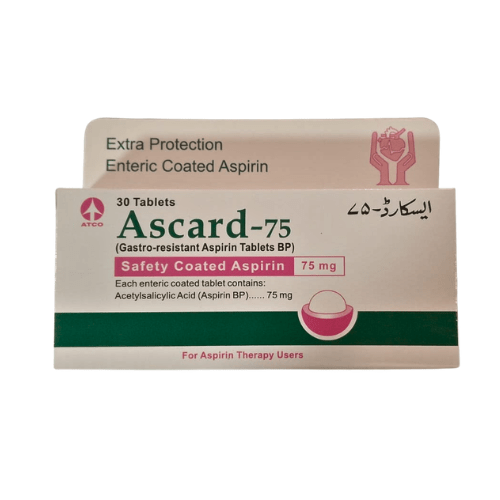
Ascard 75mg Tablets contain Aspirin and are made by Atco Laboratories Limited. Low-dose aspirin stops platelets from clumping together, lowering the risk of clots that cause heart attacks and strokes. You can order it online from Divine Medicines with home delivery across Lahore.
Quick Facts
- Brand: Ascard
- Formula (generic): Aspirin
- Manufacturer: Atco Laboratories Limited
- Drug class: Antiplatelet – low-dose aspirin
- Dosage form: Oral tablet
- Pack size: 30 tablets
Ingredients
Each tablet contains Aspirin 75 mg.
Drug Class
Antiplatelet – low-dose aspirin.
Dosage Form & Pack Size
Oral tablet. Pack of 30 tablets. Also available as a single strip.
Uses
Ascard 75mg is used for:
- Lowering the risk of heart attack and stroke in people with heart or blood vessel disease
- After a heart attack, stroke, angina or stent placement
- After bypass surgery, as directed
Dosage
The usual dose is 75–150 mg once daily, as directed by your doctor.
How to Use
Swallow the tablet with water after food. Do not crush enteric-coated tablets.
Missed Dose
Take the missed dose when you remember. If the next dose is due soon, skip the missed one. Do not take a double dose.
Overdose
If you take too much, contact your doctor or go to the nearest hospital emergency department straight away.
When Not to Use
- Active stomach ulcer or bleeding
- Bleeding disorders
- Allergy or asthma triggered by aspirin or NSAIDs
- Children under 16 (risk of Reye’s syndrome)
- Last 3 months of pregnancy
Side Effects
Common side effects may include:
- Indigestion
- Easy bruising
- Nosebleeds
- Stomach irritation
Seek urgent help for black stools, vomiting blood, wheezing, or swelling of the face.
Precautions & Warnings
- Do not stop without your doctor’s advice if you have heart disease
- Tell your doctor or dentist before any procedure
Pregnancy & Breastfeeding
Low-dose aspirin is sometimes prescribed in pregnancy for specific reasons; take it only on your doctor’s advice. Avoid higher doses in late pregnancy.
Drug Interactions
- NSAIDs such as ibuprofen can reduce its protective effect and increase bleeding risk
- Warfarin, clopidogrel and SSRIs increase bleeding risk
- Methotrexate levels may rise
Storage Instructions
Store below 30°C in a dry place, away from direct sunlight and moisture. Keep in the original pack and out of reach of children.
FAQs
What is the Ascard 75mg price in Pakistan?
Current prices for a full pack and for a single strip are shown at the top of this page. Order online from Divine Medicines for delivery in Lahore.
Can I buy a single strip of Ascard 75mg?
Yes. You can choose either a full pack or a single strip.
What is the formula of Ascard 75mg?
The formula (generic name) of Ascard 75mg is Aspirin.
Who manufactures Ascard 75mg?
Ascard 75mg is manufactured by Atco Laboratories Limited and is available at Divine Medicines with delivery across Lahore.
Why take Ascard 75mg daily?
To lower the risk of heart attack and stroke.
Should Ascard 75mg be taken with food?
Yes, after food.
Can I take ibuprofen with Ascard 75mg?
Ask your doctor; it can reduce aspirin’s protective effect.
Disclaimer
Always use this medicine strictly according to your doctor’s instructions and prescribed dosage.
 Sale!
Sale!
 Sale!
Sale!
 Sale!
Sale!
 Sale!
Sale!
 Sale!
Sale!
 Sale!
Sale!
 Sale!
Sale!
 Sale!
Sale!


 Your cart is empty


Shahzad Pervaiz –
Awesome, Great services ever