Description
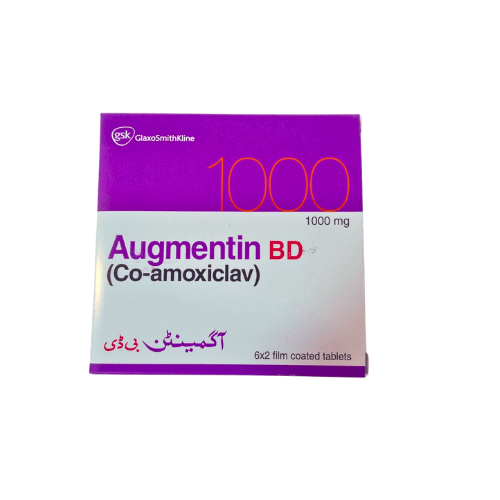
Augmentin 1g Tablets contain amoxicillin with clavulanic acid and are made by GlaxoSmithKline. Amoxicillin kills bacteria by breaking down their cell walls, and clavulanic acid stops certain bacteria from inactivating amoxicillin. Together they work against a wider range of infections than amoxicillin alone. You can order it online from Divine Medicines with home delivery across Lahore.
Quick Facts
- Brand: Augmentin
- Formula (generic): Co-Amoxiclav (Amoxicillin + Clavulanic Acid)
- Manufacturer: GlaxoSmithKline
- Drug class: Antibiotic – penicillin with beta-lactamase inhibitor
- Dosage form: Oral tablet
- Pack size: 2 strips of 6 tablets
Ingredients
Each tablet contains Amoxicillin 875 mg and Clavulanic acid 125 mg.
Drug Class
Antibiotic – penicillin with beta-lactamase inhibitor.
Dosage Form & Pack Size
Oral tablet. Available as a full pack (2 strips of 6 tablets) or as a single strip of 6 tablets.
Uses
Augmentin 1g is used for:
- Sinus, ear and throat infections
- Chest infections such as bronchitis and pneumonia
- Urinary tract infections
- Skin, soft tissue and dental infections
- Animal and human bite wounds
Dosage
Adults usually take one 625 mg tablet three times daily or one 1 g tablet twice daily for 5–14 days, depending on the infection; the 375 mg tablet is used for milder infections.
How to Use
Take at the start of a meal to reduce stomach upset and improve absorption. Swallow tablets with water.
Missed Dose
Take the missed dose as soon as you remember. If the next dose is due soon, skip the missed one. Do not double the dose.
Overdose
If you take too much, contact your doctor or go to the nearest hospital emergency department straight away.
When Not to Use
- Allergy to penicillins or cephalosporins
- Previous jaundice or liver problems with co-amoxiclav or amoxicillin
Side Effects
Common side effects may include:
- Diarrhoea
- Nausea or vomiting
- Thrush (oral or vaginal yeast infection)
- Skin rash
Stop and seek urgent help for swelling of the face or throat, breathing difficulty, a widespread rash with blisters, yellowing of the skin or eyes, or severe diarrhoea.
Precautions & Warnings
- Complete the full course even if you feel better, to stop the infection coming back and reduce resistance
- Antibiotics do not work for colds or flu caused by viruses
- Seek medical help for severe or bloody diarrhoea during or after the course
- Tell your doctor about any past allergy to antibiotics
Pregnancy & Breastfeeding
Generally considered acceptable in pregnancy and breastfeeding when prescribed by a doctor.
Drug Interactions
- Methotrexate toxicity may increase
- Warfarin effect may increase; INR may need checking
- Allopurinol increases the chance of skin rash
- Probenecid raises amoxicillin levels
Storage Instructions
Store tablets below 25–30°C in a dry place.
FAQs
What is the Augmentin 1g price in Pakistan?
Current prices for a full pack and for a single strip are shown at the top of this page. Order online from Divine Medicines for delivery in Lahore.
Can I buy a single strip of Augmentin 1g?
Yes. You can choose either a full pack or a single strip.
What is the formula of Augmentin 1g?
The formula (generic name) of Augmentin 1g is Co-Amoxiclav (Amoxicillin + Clavulanic Acid).
Who manufactures Augmentin 1g?
Augmentin 1g is manufactured by GlaxoSmithKline and is available at Divine Medicines with delivery across Lahore.
Should Augmentin 1g be taken with food?
Yes, at the start of a meal.
Can I stop Augmentin 1g when I feel better?
No. Finish the full course.
Is Augmentin 1g safe if I am allergic to penicillin?
No. Tell your doctor; a different antibiotic will be needed.
Disclaimer
Always use this medicine strictly according to your doctor’s instructions and prescribed dosage.
 Sale!
Sale!
 Sale!
Sale!
 Sale!
Sale!
 Sale!
Sale!
 Sale!
Sale!
 Sale!
Sale!
 Sale!
Sale!
 Sale!
Sale!


 Your cart is empty


Reviews
There are no reviews yet.