Description
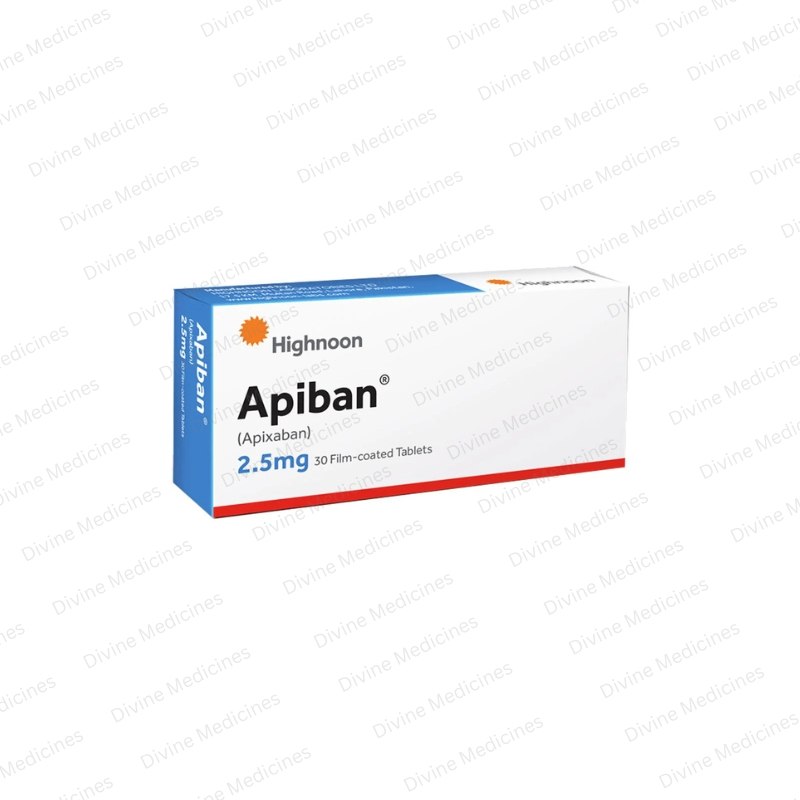
Apiban 2.5mg Tablets contain Apixaban and are made by Highnoon Laboratories. Apixaban blocks factor Xa, a key clotting protein, which reduces the risk of harmful blood clots forming in the veins, lungs or heart. You can order it online from Divine Medicines with home delivery across Lahore.
Quick Facts
- Brand: Apiban
- Formula (generic): Apixaban
- Manufacturer: Highnoon Laboratories
- Drug class: Anticoagulant (blood thinner) – direct factor Xa inhibitor
- Dosage form: Oral tablet
- Pack size: 3 strips of 10 tablets
Ingredients
Each tablet contains Apixaban 2.5 mg.
Drug Class
Anticoagulant (blood thinner) – direct factor Xa inhibitor.
Dosage Form & Pack Size
Oral tablet. Available as a full pack (3 strips of 10 tablets) or as a single strip of 10 tablets.
Uses
Apiban 2.5mg is used for:
- Reducing the risk of stroke and blood clots in people with atrial fibrillation not caused by valve disease
- Deep vein thrombosis (DVT) and pulmonary embolism (PE), and reducing the risk of them coming back
- Reducing the risk of blood clots after hip or knee replacement surgery
Dosage
For atrial fibrillation, the usual dose is 5 mg twice daily; 2.5 mg twice daily is used for some older or lighter people or those with kidney problems. For DVT/PE, treatment starts at 10 mg twice daily for 7 days, then 5 mg twice daily. After hip or knee replacement, 2.5 mg twice daily is used for 10–35 days.
How to Use
Swallow the tablet with water, twice a day about 12 hours apart, with or without food. If you cannot swallow it, it can be crushed and mixed with water or apple juice.
Missed Dose
Take the missed dose as soon as you remember the same day, then continue twice daily as normal. Do not take two doses to make up.
Overdose
An overdose increases the risk of bleeding. Seek emergency medical help immediately.
When Not to Use
- Active significant bleeding
- Liver disease with bleeding risk
- Artificial heart valves
- Taking another anticoagulant at the same time (except when switching)
- Allergy to apixaban
Side Effects
Common side effects may include:
- Bruising
- Nosebleeds or bleeding gums
- Blood in urine
- Heavy periods
- Nausea
- Anaemia
Seek urgent help for black or bloody stools, vomiting blood, coughing up blood, a severe headache, or any bleeding that will not stop.
Precautions & Warnings
- Do not stop without talking to your doctor, as stopping raises stroke and clot risk
- Tell every doctor and dentist that you take a blood thinner before any procedure
- Use a soft toothbrush and electric razor to reduce bleeding
Pregnancy & Breastfeeding
Not recommended during pregnancy or breastfeeding. Tell your doctor if you become pregnant.
Drug Interactions
- Aspirin, clopidogrel and NSAIDs such as ibuprofen increase bleeding risk
- Ketoconazole, itraconazole and HIV protease inhibitors raise apixaban levels
- Rifampicin, carbamazepine and phenytoin lower apixaban levels
- SSRI/SNRI antidepressants may increase bleeding risk
Storage Instructions
Store below 30°C in a dry place, away from direct sunlight and moisture. Keep in the original pack and out of reach of children.
FAQs
What is the Apiban 2.5mg price in Pakistan?
Current prices for a full pack and for a single strip are shown at the top of this page. Order online from Divine Medicines for delivery in Lahore.
Can I buy a single strip of Apiban 2.5mg?
Yes. You can choose either a full pack or a single strip.
What is the formula of Apiban 2.5mg?
The formula (generic name) of Apiban 2.5mg is Apixaban.
Who manufactures Apiban 2.5mg?
Apiban 2.5mg is manufactured by Highnoon Laboratories and is available at Divine Medicines with delivery across Lahore.
Do I need blood tests with Apiban 2.5mg?
Routine INR tests are not needed, unlike warfarin.
Can I take painkillers with Apiban 2.5mg?
Paracetamol is usually preferred; avoid NSAIDs like ibuprofen unless your doctor agrees.
What if I need surgery or dental work on Apiban 2.5mg?
Tell your doctor or dentist; it may need to be paused before the procedure.
Disclaimer
Always use this medicine strictly according to your doctor’s instructions and prescribed dosage.
 Sale!
Sale!
 Sale!
Sale!
 Sale!
Sale!
 Sale!
Sale!
 Sale!
Sale!
 Sale!
Sale!
 Sale!
Sale!
 Sale!
Sale!


 Your cart is empty


Reviews
There are no reviews yet.