Description
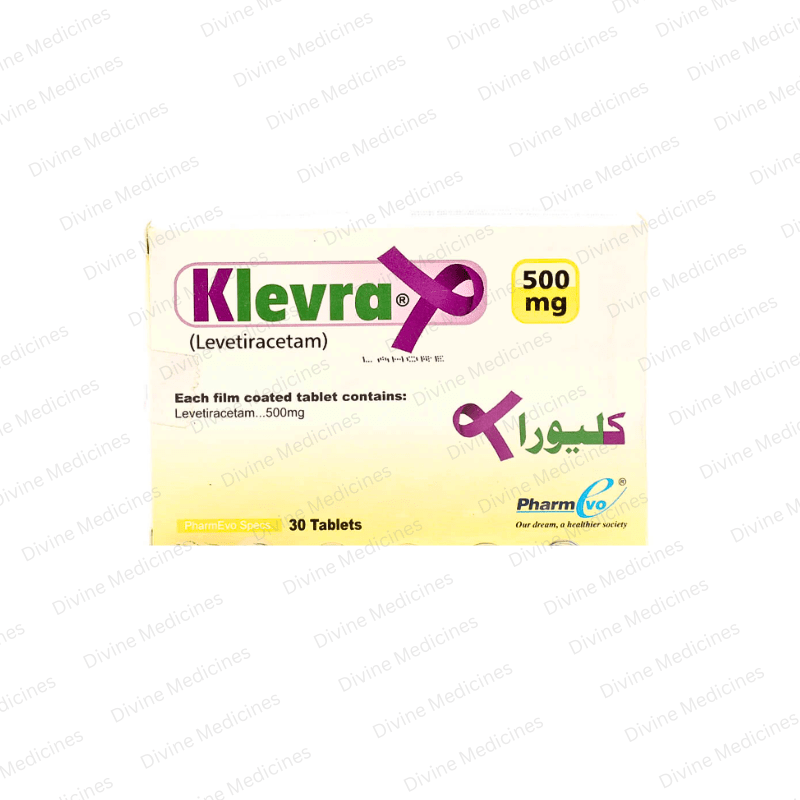
Klevra 500mg Tablets contain Levetiracetam and are made by PharmaEvo. Levetiracetam calms abnormal electrical activity in the brain. It is widely used because it has few interactions with other medicines and does not usually need blood-level monitoring. You can order it online from Divine Medicines with home delivery across Lahore.
Quick Facts
- Brand: Klevra
- Formula (generic): Levetiracetam
- Manufacturer: PharmaEvo
- Drug class: Antiepileptic (anticonvulsant)
- Dosage form: Oral tablet
- Pack size: 3 strips of 10 tablets
Ingredients
Each tablet contains Levetiracetam 500 mg.
Drug Class
Antiepileptic (anticonvulsant).
Dosage Form & Pack Size
Oral tablet. Available as a full pack (3 strips of 10 tablets) or as a single strip of 10 tablets.
Uses
Klevra 500mg is used for:
- Partial-onset seizures, alone or with other epilepsy medicines
- Myoclonic seizures in juvenile myoclonic epilepsy, as add-on therapy
- Primary generalised tonic-clonic seizures, as add-on therapy
Dosage
Adults usually start with 250–500 mg twice daily. The dose may be increased every 2 weeks by 500 mg twice daily, up to a maximum of 1,500 mg twice daily (3,000 mg per day). Children’s doses are based on body weight, and the dose is lowered in kidney disease.
How to Use
Swallow the tablet whole with water, with or without food, twice a day at the same times. Do not stop suddenly, as this can trigger seizures.
Missed Dose
Take the missed dose when you remember. If the next dose is due soon, skip the missed one. Do not take a double dose.
Overdose
An overdose can cause drowsiness, agitation, aggression, slowed breathing or loss of consciousness. Get emergency medical help immediately.
When Not to Use
- Allergy to levetiracetam or any ingredient
Side Effects
Common side effects may include:
- Drowsiness and tiredness
- Dizziness
- Headache
- Irritability or mood changes
- Sore throat or runny nose
Seek urgent help for thoughts of self-harm, unusual aggression or behaviour changes, or a serious skin reaction.
Precautions & Warnings
- A small number of people on antiepileptic medicines develop low mood or suicidal thoughts; contact your doctor immediately if this happens
- Mood and behaviour changes such as irritability or aggression can occur; tell your doctor
- Do not drive until you know how it affects you
- Dose adjustment is needed in kidney disease
Pregnancy & Breastfeeding
Do not stop levetiracetam on your own if you become pregnant; speak to your doctor first, as uncontrolled seizures can harm both mother and baby. It passes into breast milk; your doctor will advise on breastfeeding.
Drug Interactions
- Alcohol may increase drowsiness
- Methotrexate levels may rise
- Levetiracetam has few other significant drug interactions
Storage Instructions
Store below 30°C in a dry place, away from direct sunlight and moisture. Keep in the original pack and out of reach of children.
FAQs
What is the Klevra 500mg price in Pakistan?
Current prices for a full pack and for a single strip are shown at the top of this page. Order online from Divine Medicines for delivery in Lahore.
Can I buy a single strip of Klevra 500mg?
Yes. You can choose either a full pack or a single strip.
What is the formula of Klevra 500mg?
The formula (generic name) of Klevra 500mg is Levetiracetam.
Who manufactures Klevra 500mg?
Klevra 500mg is manufactured by PharmaEvo and is available at Divine Medicines with delivery across Lahore.
Can I stop Klevra 500mg suddenly?
No. Stopping suddenly can trigger seizures; your doctor will reduce the dose gradually.
Does Klevra 500mg cause mood changes?
Irritability or mood changes can occur; tell your doctor if you notice them.
Is Klevra 500mg taken twice a day?
Yes. It is usually taken twice daily, about 12 hours apart.
Can Klevra 500mg be taken with other epilepsy medicines?
Yes. It is often used together with other epilepsy medicines.
Disclaimer
Always use this medicine strictly according to your doctor’s instructions and prescribed dosage.
 Sale!
Sale!
 Sale!
Sale!
 Sale!
Sale!
 Sale!
Sale!
 Sale!
Sale!
 Sale!
Sale!
 Sale!
Sale!
 Sale!
Sale!


 Your cart is empty


Reviews
There are no reviews yet.